
In This Guide
What Is an Electricity Facts Label?
In Texas, an Electricity Facts Label, usually called an EFL, is a standardized disclosure document that explains the pricing and key terms of a retail electricity plan. Electricity providers provide an EFL for each plan so shoppers can better understand how the plan works and compare it with other options.
The Public Utility Commission of Texas (PUCT) sets requirements for the information included in an EFL. While the exact appearance can vary by electricity provider, EFLs generally follow a similar structure and disclose the information consumers need to understand how a plan calculates their electricity costs.
Think of an EFL as the nutrition label for an electricity plan. The advertised rate may get your attention, but the EFL shows the charges, pricing rules, and contract terms behind that rate.
The 4 Things an EFL Tells You
What You'll Pay
Average prices at 500, 1,000 and 2,000 kWh, the provider's energy charges, TDU delivery charges, base charges, and other recurring fees.
How the Pricing Works
Whether the plan uses straightforward fixed pricing or includes features such as bill credits, minimum-usage rules, or time-of-use pricing.
What You're Committing To
The contract length, early termination fee, product type, and circumstances under which the price can change.
Other Required Disclosures
Renewable energy content and other information required as part of the plan disclosure.
Before You Choose a Plan
Always open the EFL. Two plans with similar advertised rates can calculate your bill very differently. The three average prices at the top are only the starting point. To understand what you could actually pay, you need to understand the charges and pricing rules used to calculate those numbers.
Let's Read a Real Electricity Facts Label
We'll use the Reliant Power On 12 plan in the CenterPoint Energy service area as our example. This is a relatively straightforward fixed-rate plan, which makes it a good place to learn the fundamentals.
We'll start with the actual EFL, then break down where to find the most important information and how the numbers work together to calculate the plan's average price.
How This EFL Is Organized
Electricity Price
This is where you'll find the average prices at 500, 1,000 and 2,000 kWh, along with the charges used to calculate those prices.
Other Key Terms and Questions
This section points you to the plan's Terms of Service for additional fees, deposit policies and other terms.
Disclosure Chart
This is where you'll find the product type, contract term, early termination fee, price-change rules and other required plan disclosures.
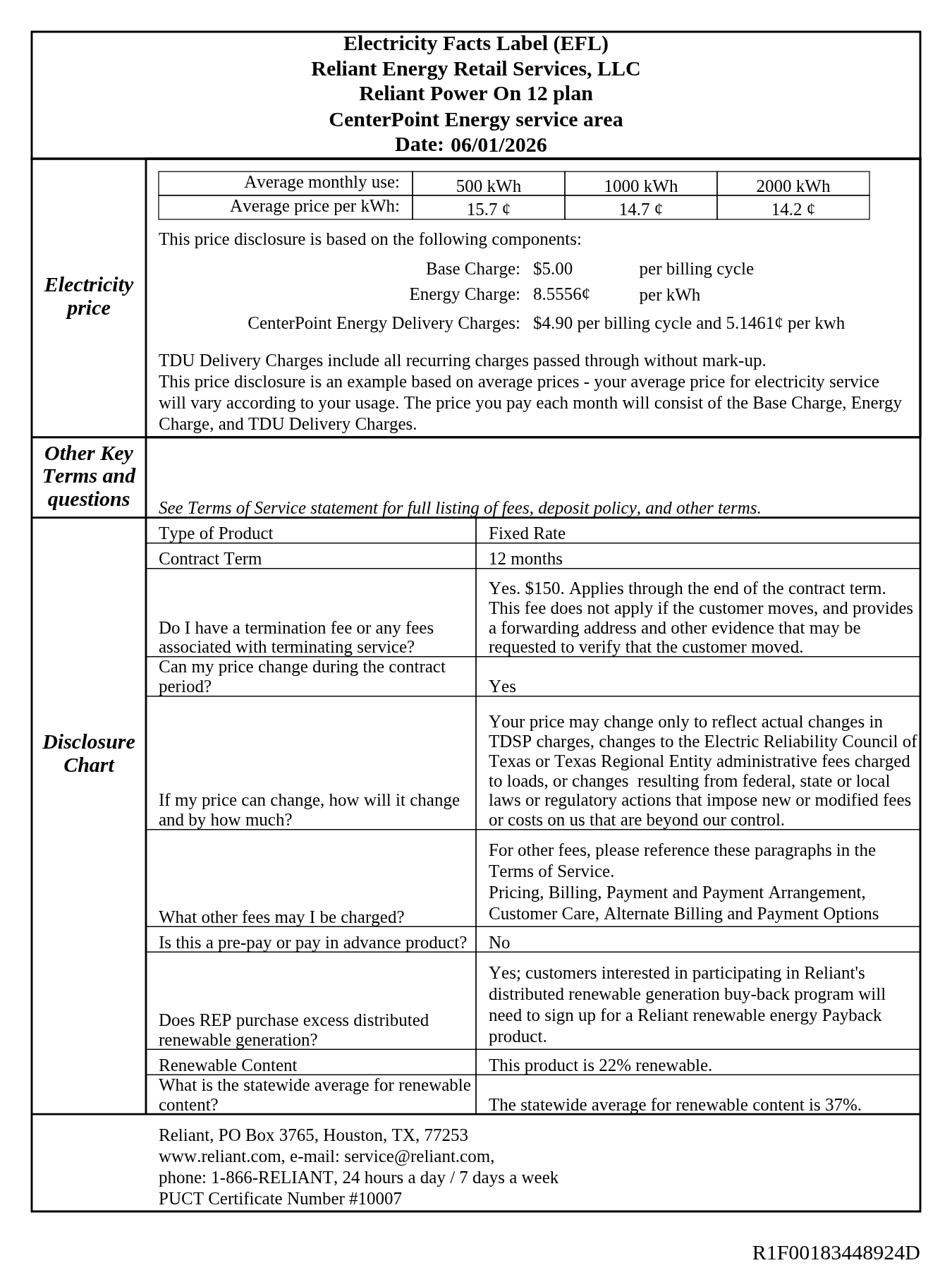
Plan pricing shown is from the EFL dated June 1, 2026 and is used here for educational purposes. Electricity plan pricing changes over time.
Pricing Walkthrough
Start at the Top: How the Plan Calculates Your Price
The three prices at the top of an EFL are examples of the plan's average price at different usage levels. To understand where those numbers come from, look at the charges listed directly underneath them.
Step 1
Read the Average Prices

Scroll to read the full table →
500 kWh
15.7¢
per kWh
1,000 kWh
14.7¢
per kWh
2,000 kWh
14.2¢
per kWh
Notice how the average price falls as usage increases. The charges underneath the average prices show us why.
Step 2
Find the Charges Underneath
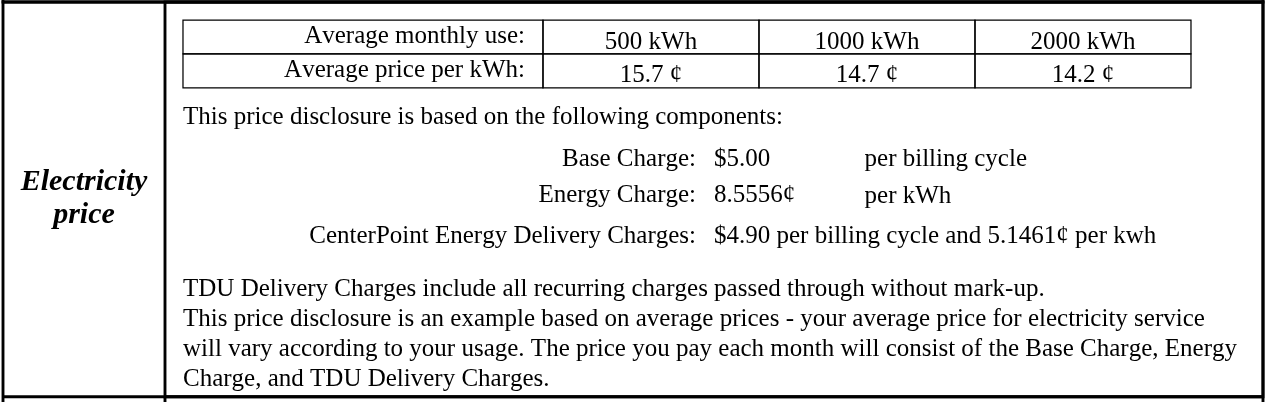
Scroll to read the full section →
Retail Electricity Provider Charges (Reliant)
8.5556¢ per kWh
Energy charge
$5.00 per billing cycle
Base charge
Reliant is the retail electricity provider. These are Reliant's charges for supplying your electricity.
TDU Delivery Charges (CenterPoint)
5.1461¢ per kWh
Delivery usage charge
$4.90 per billing cycle
Monthly delivery charge
CenterPoint is the TDU. These are CenterPoint's charges for delivering electricity to your home.
Step 3
Run the Math at 1,000 kWh
Now let's calculate the REP and TDU charges at 1,000 kWh to recreate the 14.7¢ average price shown on the EFL.
| Charge | How It's Charged | Calculation | Cost |
|---|---|---|---|
| Retail Electricity Provider Charges (Reliant) | |||
| Energy charge | How it's charged8.5556¢ per kWh | Calculation1,000 kWh × 8.5556¢ | Cost$85.56 |
| Base charge | How it's charged$5.00 flat fee per billing cycle | Calculation$5.00 | Cost$5.00 |
| TDU Delivery Charges (CenterPoint) | |||
| Delivery usage charge | How it's charged5.1461¢ per kWh | Calculation1,000 kWh × 5.1461¢ | Cost$51.46 |
| Monthly delivery charge | How it's charged$4.90 flat fee per billing cycle | Calculation$4.90 | Cost$4.90 |
| Estimated bill | $146.92 | ||
$146.92 ÷ 1,000 kWh =
14.7¢ per kWh
This matches the 14.7¢ average price shown at 1,000 kWh on the EFL. The EFL rounds the average price to one decimal place.
Why the Average Price Changes
The fixed monthly charges are spread across more kWh as the amount of electricity you use increases. That's why this plan's average price falls from 15.7¢ at 500 kWh to 14.2¢ at 2,000 kWh.
Other plans may include bill credits, minimum-usage fees or time-of-use pricing that change the math more dramatically. That's why the average price alone never tells the whole story.
Plan Terms & Disclosures
Next, Read the Plan Terms and Disclosures
After you understand the price, move to the Disclosure Chart. This section explains the contract terms, fees and other rules that come with the plan.
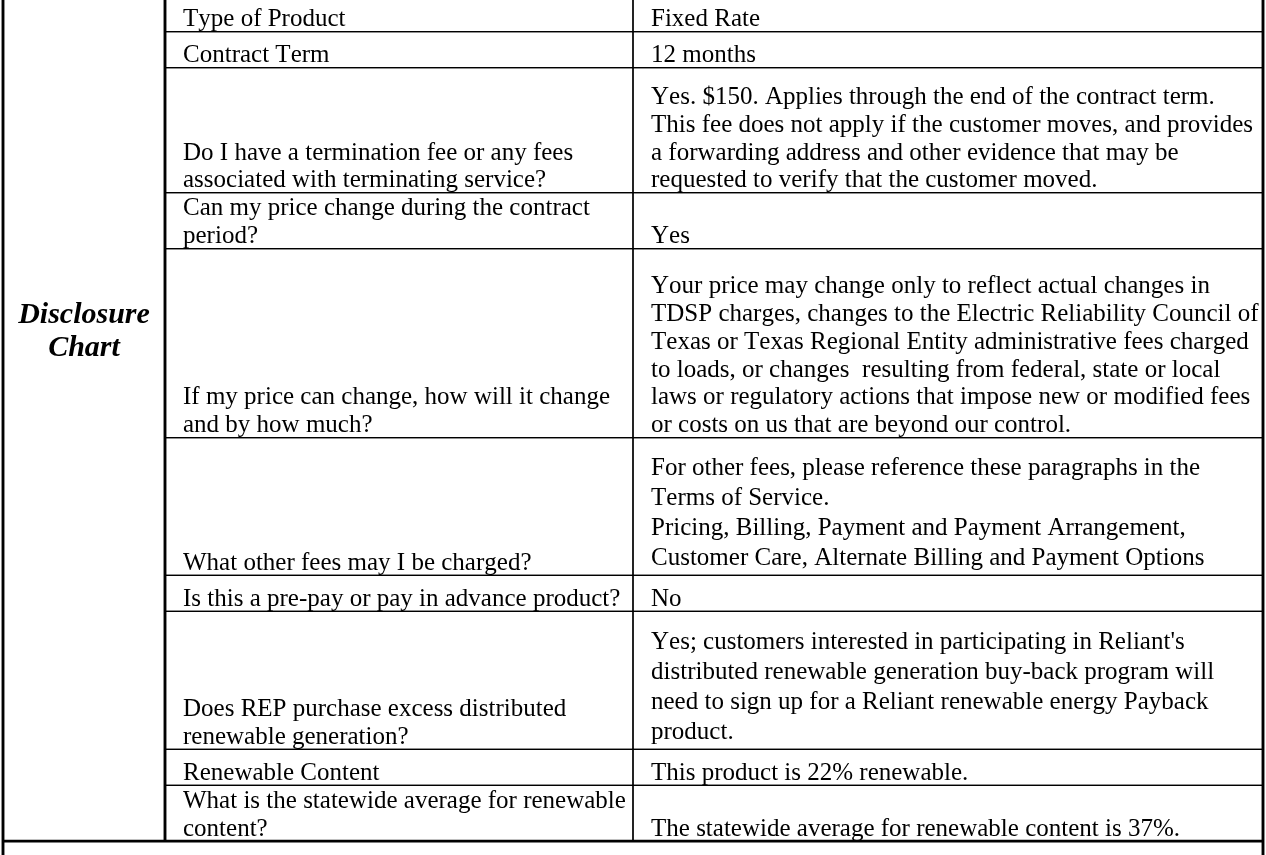
Scroll to read the full chart →
This is the Disclosure Chart from the lower portion of the actual Reliant Power On 12 EFL. There are four things to check here.
01
Check the Plan Type and Contract Term
Fixed Rate
Product Type
12 Months
Contract Term
The product type tells you how the plan is priced, while the contract term tells you how long the agreement lasts. This plan is a fixed-rate product with a 12-month contract.
02
Find the Early Termination Fee
$150
Early Termination Fee
This is the fee Reliant may charge if you cancel the plan before the contract ends.
The EFL says the fee does not apply if you move and provide the required verification.
03
Check When the Price Can Change
A fixed-rate plan does not mean every charge on your bill is frozen for the entire contract.
This EFL says the price may change to reflect:
- TDU delivery charge changes
- ERCOT or Texas Regional Entity administrative fee changes
- Changes resulting from federal, state or local laws or regulatory actions
A fixed rate protects the plan's energy price structure, but TDU delivery charges, administrative fees and certain regulatory costs can still change.
04
Scan the Remaining Disclosures
The rest of the Disclosure Chart covers additional fees, prepaid status and renewable content. Many fee details and other account terms are explained in the Terms of Service, so review that document along with the EFL before choosing a plan.
Other Fees
The EFL may direct you to the Terms of Service for additional fees and account terms. Review the TOS along with the EFL before enrolling.
Prepaid or Advance Product
This plan is not a prepaid or pay-in-advance electricity product.
Renewable Content
22%
Plan Renewable Content
37%
Texas Statewide Average
The EFL discloses the percentage of renewable energy content in the product and provides the statewide average for comparison.
Other Pricing Structures You'll See
The Reliant example uses a relatively straightforward fixed-rate pricing formula. Other electricity plans may use different pricing structures or billing models, including bill credits, time-of-use pricing and prepaid service.
The same basic process still applies: read the EFL carefully, identify every charge and pricing rule, and understand how the plan works before deciding whether it fits your usage.
Bill-Credit Plans
A bill credit may apply only when your monthly usage falls within a specific range or crosses a certain threshold. That can cause the average price to change sharply when your usage falls just below or above the qualifying level.
What to Check on the EFL
Look for the exact usage requirement, credit amount and what happens when your usage falls outside the qualifying range.
Time-of-Use Plans
The price you pay may depend on when you use electricity. A plan may offer free or discounted electricity during certain hours while charging a different rate during other periods.
What to Check on the EFL
Look for the exact time periods, the price charged during each period and any days or hours excluded from the offer.
Prepaid Plans
Prepaid electricity plans require you to pay for electricity before you use it rather than receiving a traditional monthly bill. The EFL can help you identify whether a plan is prepaid and understand the pricing and other terms that apply.
What to Check on the EFL
Look for whether the plan is prepaid, how the electricity price is calculated, and any fees or other terms that may apply.
The Energy Insider Tip
Never view the 500, 1,000 and 2,000 kWh average prices in isolation. Two plans can show a similar average price at 1,000 kWh while producing very different bills at your actual usage level, or at different times of day. A more complicated EFL does not automatically mean a bad plan. What matters is whether the pricing structure fits how your home actually uses electricity.
The EFL Tells You How the Plan Works, Not Whether It Fits Your Home
An EFL can show you exactly how a plan calculates your bill. But it cannot tell you how much electricity your home will use, or which electricity plan fits your home.
For every electricity plan, how much electricity you use matters. With time-of-use plans, when you use electricity can matter too. That means two households can choose the same plan and still have very different results.
An EFL tells you how a plan charges you. Your usage tells you whether it's a good plan for you.
How Much You Use
Your total electricity usage affects what you pay on every plan. Fixed monthly charges, bill credits, usage thresholds and other pricing features can all change the effective price at different usage levels.
When You Use It
On time-of-use plans, the timing of your electricity usage can also affect your cost. Free nights, discounted periods or higher daytime rates only help if your usage pattern fits the pricing structure.
Your EFL Checklist: What to Check Before You Enroll
Before choosing an electricity plan, use the EFL to answer these questions. The goal is not just to find the advertised rate. It is to understand how the plan will calculate your bill and whether the pricing structure fits your home.
Pricing
- What is the REP energy charge?
- Does the REP charge a monthly base fee?
- What are the TDU per-kWh and monthly delivery charges?
- Are there bill credits, usage thresholds, minimum-usage fees or other pricing rules?
- Does the price change based on when I use electricity?
Contract & Plan Terms
- How long is the contract?
- What is the early termination fee?
- Can any part of the price change during the contract?
- Is the plan prepaid?
Fit for Your Home
- What would this pricing formula cost at my actual electricity usage?
- What would this plan cost during my lower- and higher-usage months?
- If the plan uses time-of-use pricing, when does my home actually use electricity?
The Energy Insider Tip
If you cannot explain how a plan calculates your bill after reading the EFL, do not enroll based on the advertised rate alone.